
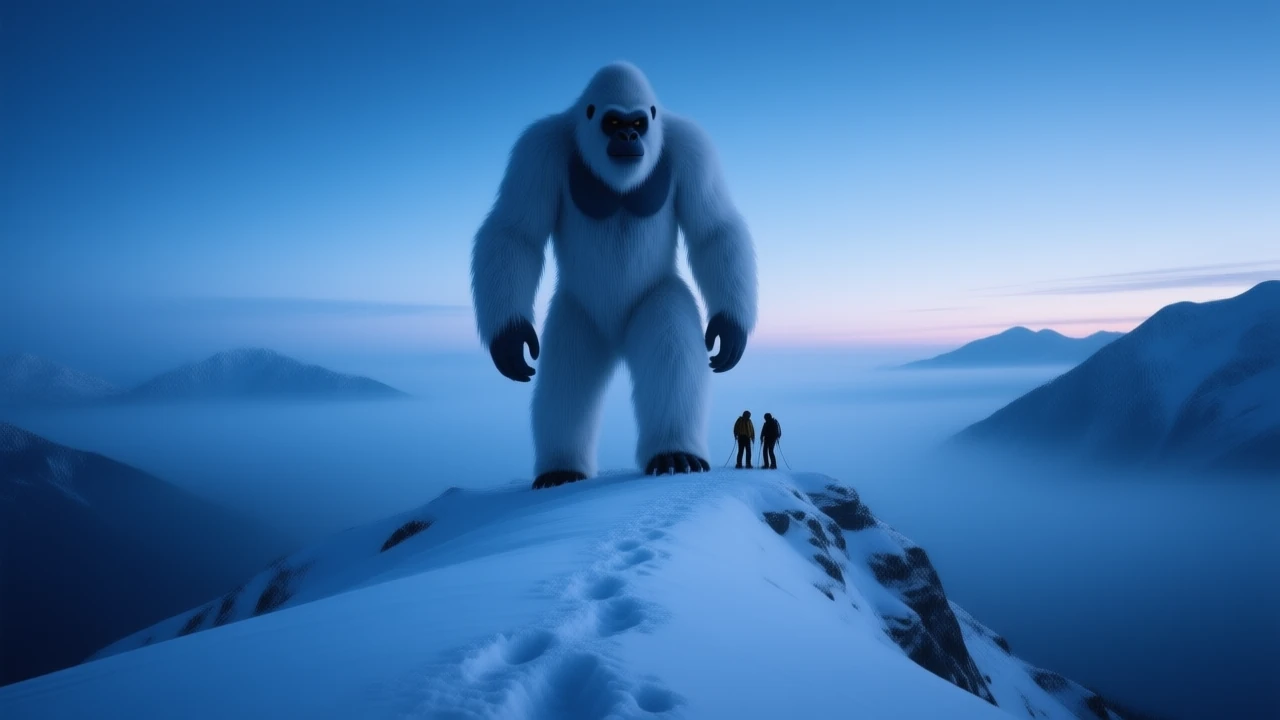
Yeti Sightings Once Terrified Everest Climbers — Then Hollywood Turned It Into a Cuddly Sidekick
A Footprint on Everest, 1921
The Yeti belongs to the same rough family of cryptid as Bigfoot, its cousin we've already covered on this site, and the two share more than just a family resemblance in how they've been treated over the decades. Like Bigfoot, the Yeti used to be filed under violent and terrifying by default. That reputation goes back at least to 1921, during the Mount Everest Reconnaissance Expedition, when climbers reported a set of enormous footprints crossing the snow at high altitude — an incident that basically launched the Yeti as a subject of Western fascination in the first place.
The Sightings That Actually Made the Record Books
The documented sighting history since 1921 reads like a slow drip of near-misses rather than one dramatic encounter. In 1951, mountaineer Eric Shipton photographed a large footprint near the Menlung Glacier that's still cited as the single most convincing piece of physical evidence anyone has produced. Then in 1986, English physicist Anthony Wooldridge, on a charity run through the Himalayas, claimed he saw a Yeti standing roughly 150 meters away — close enough that he later spent years defending the account, and just far enough that he eventually admitted it might have been a rocky outcrop playing tricks on him. That mix of conviction and doubt basically defines the entire history of the hunt for the creature.
What Science Thinks Actually Left Those Prints
The leading explanations line up with the same biological reasoning used everywhere else in cryptozoology — the kind of biological breakdown that also gets applied to Bigfoot and to Scotland's most famous lake monster. Misidentified bears, wind-melted footprints stretching into something larger than their actual source, and simple pareidolia account for most reported cases, the same way a 2019 eDNA study reshaped the conversation around Loch Ness sightings a continent away. None of that fully closes the file, which is exactly why a running list of top sightings keeps getting updated instead of retired.
The Monster That Helped Me Fight Terracotta Soldiers
My own earliest memory of the Yeti legend probably traces back to the well-known Mummy franchise — specifically the third installment, built around the Terracotta Army and set in China, where a Yeti shows up partway through. At that point in the story the creature actually helps the main characters, but its visual design was still built almost entirely around horror and violence. It looked like something that could kill you first and reconsider later, which, at the time, felt like the correct default for a creature nobody had ever definitively photographed.
Then the Snowman Got a Face Like a Golden Retriever
Later on, though — maybe because the adorable image of the Abominable Snowman in Disney's Monsters, Inc. sank deeper and deeper into public consciousness — the Yeti, like Bigfoot, started drifting down the same heartwarming path starting with works from the late 2010s onward. DreamWorks' Abominable is the clearest example: a towering white creature reimagined as a gentle, loyal companion a kid could hug, a world away from anything crossing a glacier to attack a climber.
I’ll Admit It: I’m Getting a Bit Tired of This Formula
Honestly, I've come around to feeling a little dismissive toward this whole trend of handing monsters a modified, softened inner life — the same formula shows up too often, and after a while it gets a bit tiring to sit through again. These days I actually find myself appreciating films and shows that let a monster keep its frightening edge, because in the real world, and in the animal kingdom generally, insisting that everything underneath is warm and cuddly just isn't realistic. Predators are predators. Something that leaves a footprint the size of a dinner plate on the Menlung Glacier doesn't need a redemption arc to be interesting.
Cute Monsters Sell Tickets, and That’s Probably the Whole Answer
Part of this shift is likely tied to Hollywood's broader de-stigmatization trend — or maybe it's just political correctness, honestly I'm not entirely sure which — and part of it is simpler than that: giving a towering, imposing creature a gentle inner life produces exactly the kind of gap-moe contrast between appearance and personality that tends to perform very well at the box office. Hotel Transylvania and Wreck-It Ralph both leaned on the same mechanic with different monsters, and it worked well enough that a Himalayan cryptid was never going to be the exception.
Whatever Left That Print at Menlung
Whatever actually crossed that glacier in 1951, or stood 150 meters from Anthony Wooldridge in 1986, it clearly wasn't consulting a script from a DreamWorks writers' room. The gap between those two versions of the Yeti — the one in old expedition reports and the one voiced for children today — says a lot less about the Himalayas than it does about which version of a monster we currently feel like paying to watch.