Case File: Point Pleasant, 1966. A Harbinger Takes Flight.
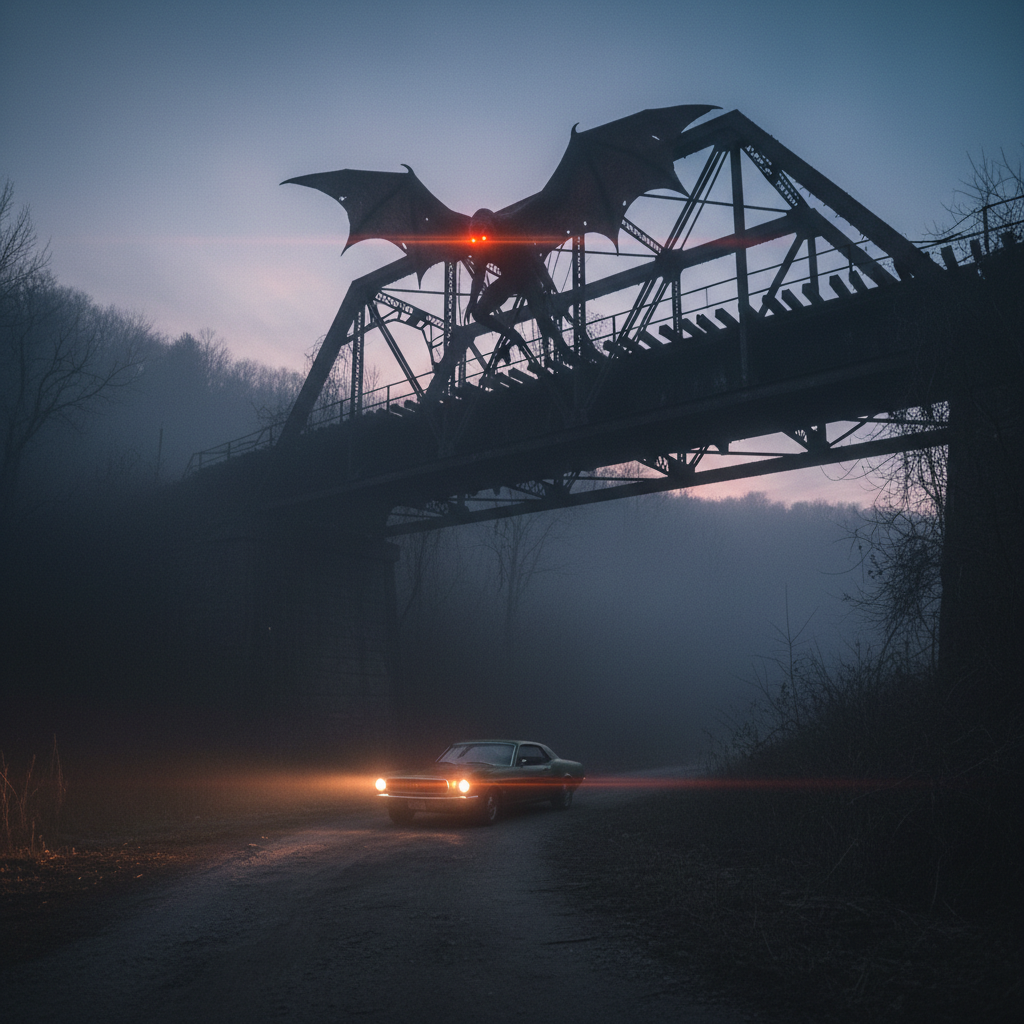
On December 15, 1967, at the height of evening rush hour, the Silver Bridge connecting Point Pleasant, West Virginia, to Gallipolis, Ohio, groaned under the weight of holiday traffic before collapsing into the icy waters of the Ohio River. Forty-six people perished. In the aftermath, a chilling narrative took root, one that had been whispered for thirteen months prior. It was the story of a seven-foot-tall, winged humanoid with glowing red eyes, a creature the local press had dubbed the Mothman. Eyewitnesses claimed to have seen it near the bridge in the days leading up to the disaster. This single, tragic event serves as the perfect crucible for examining the fundamental cryptids vs urban legends differences. Was the Mothman a tangible, biological entity—a cryptid—whose presence was merely coincidental? Or was it the manifestation of a modern myth, a harbinger of doom retrospectively woven into the fabric of a community's trauma? This case forces us to move beyond simple categorization and into the heart of how we process the unknown. The entity itself is a question of cryptozoology; the story that surrounds it is an act of digital folklore, a legend born from anxiety and grief.
The Core Essence: A Question of Biology vs. A Warning in Narrative
At its core, the distinction between a cryptid and an urban legend lies in its fundamental question. A cryptid poses a zoological problem: Does this creature exist? The entire field of cryptozoology, from Bigfoot to the Loch Ness Monster, is predicated on the search for a biological specimen, a tangible piece of evidence that would move an animal from folklore to textbook. The pursuit is one of scientific validation, even if the methods are often deemed pseudoscientific. An analysis of local legends of cryptids map shows these entities are often tied to specific, isolated ecosystems—dense forests, deep lakes, remote mountains—where an unknown species could theoretically survive undetected. The narrative surrounding a cryptid is secondary to its alleged physical existence.
An urban legend, conversely, poses a sociological or moral problem: What does this story warn us about? Its power is not in its biological plausibility but in its narrative resonance. Consider 'The Hookman,' a tale of a teenage couple parked in a lover's lane who narrowly escape a hook-handed killer. No one is searching for a one-handed man; the story's purpose is to serve as a cautionary tale about youthful indiscretion and vulnerability. It's a piece of social code, a modern fable that adapts to new anxieties. As explored in Cryptids and Urban Legends: Modern Rumor, Fear, and Fringe Belief, these legends are mirrors reflecting societal fears. The Mothman case straddles this line perfectly. The creature sightings from 1966 represent the cryptid: a strange, unidentifiable animal. The story that it was a portent of the Silver Bridge collapse is the urban legend: a narrative constructed after the fact to make sense of senseless tragedy, transforming a biological anomaly into a supernatural omen.
Comparative Analysis: Mechanisms of Belief and Transmission
To truly grasp the distinction, we must compare their lifecycles. Cryptids propagate through a chain of anecdotal evidence: eyewitness reports, blurry photographs, plaster casts of footprints. The historical evidence of the mothman consists almost entirely of such accounts from residents near the 'TNT Area,' a former munitions site. This evidence is presented, debated, and analyzed within communities dedicated to finding a physical creature. The goal is to prove its existence. The primary medium is the case file, the field report, the documentary interview. It's a framework of amateur investigation mimicking scientific inquiry.
Urban legends, however, propagate through narrative contagion. Their 'evidence' is the story itself—its believability, its emotional impact, its chilling punchline. The legend of the 'Killer in the Backseat' requires no physical proof. Its effectiveness is measured by the shiver it sends down your spine and the reflexive glance you take in your rearview mirror. It spreads not through investigation but through repetition: slumber parties, campfire stories, and in the modern era, chain emails and viral social media posts. Its evolution is a function of societal anxiety. In the 1970s, it reflected fears of random violence; today, it might be retold with a rideshare driver as the protagonist. The Mothman legend's transmission reflects this dual nature. The initial sightings spread like a cryptid report—local news, word-of-mouth. But after the bridge collapse, and especially after John Keel's 1975 book *The Mothman Prophecies*, the narrative became a full-fledged urban legend, a modern myth about technology, disaster, and supernatural warning, spreading far beyond the confines of cryptozoology.
Cultural Connections: The Psyche of Place and Time
Neither cryptids nor urban legends exist in a vacuum. They are deeply embedded in the cultural and psychological landscape of their time. A cryptid is often an extension of local folklore, a genius loci or spirit of a place given a modern, biological framing. For the people of West Virginia in the 1960s, a region grappling with industrial change and Cold War anxieties, the appearance of a strange creature in a polluted, abandoned industrial zone—the TNT area—was profoundly resonant. It was a monster born from the toxic runoff of the 20th century, a physical manifestation of a poisoned and unsettling landscape. The Global Encyclopedia of Urban Legends documents how such creatures often become icons of regional identity.
Urban legends, on the other hand, are more direct reflections of widespread, contemporary social anxieties. The fear of tainted Halloween candy reflects a loss of community trust; the legend of 'Slender Man,' born on the Something Awful forums in 2009, perfectly encapsulates the terror of the digital uncanny valley and the faceless dread of the internet age. The Mothman's transformation from cryptid to legend was fueled by the collective trauma of the Silver Bridge collapse. The community needed a framework to process the event, and the mysterious creature provided a supernatural explanation, a narrative that offered a dark, cosmic order to a random, mechanical failure. It allowed a terrifying event to be reframed as a fated tragedy, foretold by an otherworldly messenger. This is the ultimate function of the urban legend: to impose narrative onto chaos. While a biological explanation for cryptid sightings might point to a misidentified Sandhill Crane or owl, it can never satisfy the human need for meaning that the legend provides.
The Investigator's Checklist: Decoding the Phenomenon
The line between a cryptid report and an urban legend can be blurry, as the Mothman case demonstrates. A cryptid can become the seed of a legend, and a legend can sometimes inspire a search for a non-existent cryptid. As digital folklorists and critical thinkers, we must be equipped to dissect these phenomena. When encountering a strange report or a chilling story, it is crucial to move beyond passive acceptance and engage in active analysis. The goal is not necessarily to 'debunk,' but to understand the deeper human and social currents at play. What does this story, whether of a creature or a cautionary event, tell us about the people who tell it?
Actionable Checklist for Analysis:
- Identify the Core Question: Is the story primarily asking "What is it?" (likely a cryptid) or "What does this mean/warn against?" (likely an urban legend). Trace the central focus of the narrative.
- Analyze the Evidence Type: Is the proof presented as anecdotal and physical (footprints, sightings, recordings), aiming for scientific validation? Or is the 'proof' the emotional impact and internal logic of the story itself?
- Trace the Transmission Vector: How did you hear this story? Did it come from an investigative report, a cryptozoology forum, or was it shared as a frightening tale between friends, on social media, or as a cautionary email? The medium is often the message.
- Examine the Socio-Cultural Context: What fears or anxieties were prevalent when and where the story originated? Does the narrative tap into contemporary concerns about technology, social change, crime, or the unknown?
- Map the Narrative's Purpose: Does the story exist to document a potential new species, or does it serve to enforce a social norm, express a collective fear, or provide a supernatural explanation for a traumatic event?