Where Did Kuchisake-Onna Really Come From — a Samurai's Mistress, a Convicted Woman, or a Botched Surgery?
A Japanese Monster With No Foreign Twin
Most horror legends can be matched with a cousin from somewhere else. A vengeful ghost in white, a creature in the woods, a game that summons something at midnight: change the language and you usually find the same shape. Kuchisake-onna is one of the few figures I can’t do that with. As far as I can tell, no other country has produced anything quite like her, and that makes her unusual even inside the wider cross-cultural folklore this site keeps comparing. The version most people picture today comes from Koji Shiraishi’s 2007 film about her, which is probably where a generation of viewers first met the woman in the surgical mask.
Three Origins, Nobody Agrees
Where she came from depends on who is telling it. One camp traces her back to the Edo period and a woman convicted of a crime, punished with mutilation so that her mouth could never close properly. Another says she was a samurai’s mistress, and her husband cut her mouth open as punishment for infidelity. The third camp, the ones who think the legend is much younger than anyone admits, points at cosmetic surgery gone wrong. Even the era is disputed: Wikipedia leans toward the 17th to 19th centuries, while other retellings push it back to the Heian period. The yokai catalogues file her under the usual explanation for angry ghosts: people who died violently and were never properly mourned.
The Question That Never Changes
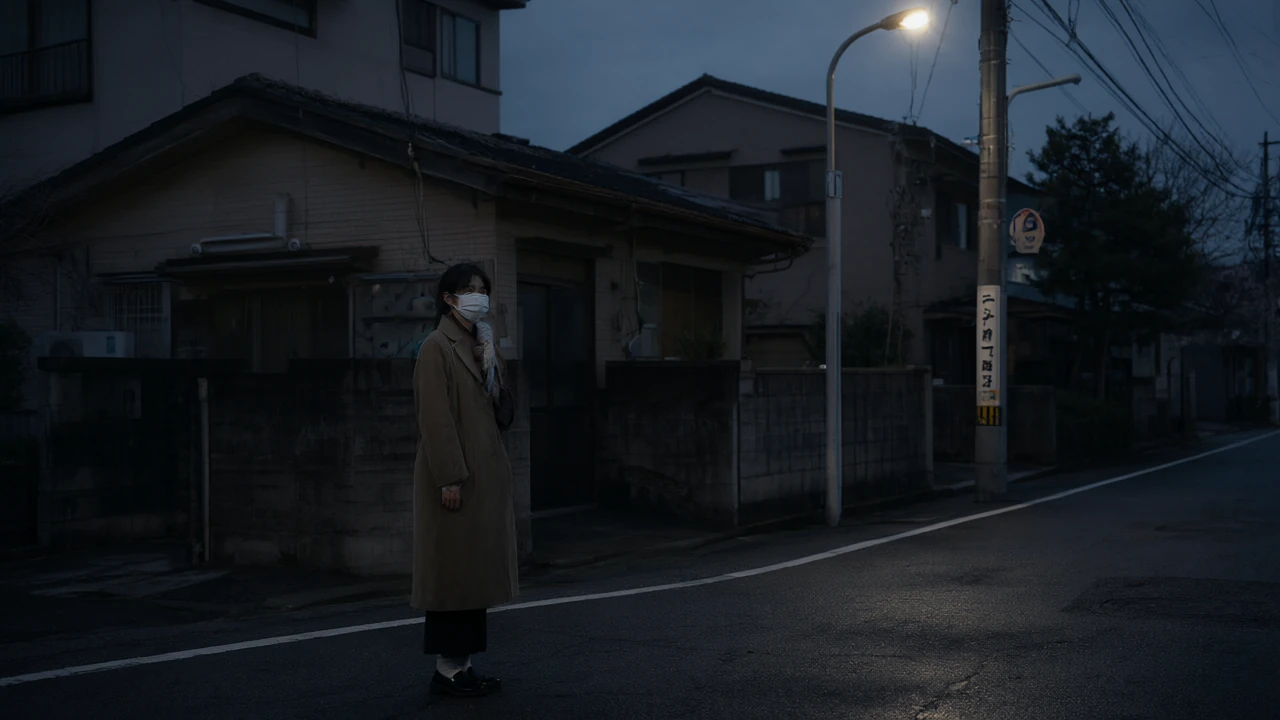
The odd part is that whichever origin you prefer, the encounter itself is identical. She stops you and asks whether you think she’s pretty. Say no, and she kills you on the spot. Say yes, and she pulls away whatever has been covering her face and asks again: “How about now?” A second no gets you killed. A second yes ends with your own mouth being cut to match hers. It’s a trap with no safe door, which is probably why the story survives every retelling. You can swap the backstory freely and the scene still works.
A Symbol More Than a Story
She is only a legend, but the image went in deep. Kuchisake-onna has become shorthand for Japanese horror, and she keeps turning up in other work: Jujutsu Kaisen, which is hugely popular right now, uses her, and so does the older Jigoku Sensei Nube. A character doesn’t get cameos in manga and anime two decades apart unless audiences already recognise her at a glance.
The Winter She Closed Schools in Gifu
Part of why she’s so widely known is that she once caused an actual panic. In 1979, in Gifu, a newspaper reported that people had sighted her. Local fear spread fast enough that schools sent children home together in groups, and parents organised patrol teams to walk them back. That detail is what makes the legend more than a campfire story, and it fits the pattern in our piece on how rumors cause mass hysteria: a vivid, specific monster gives a vague anxiety a shape that adults can organise against. Nobody patrols for “something bad might happen.” They patrol for a woman in a mask.
Why the Backstory Barely Matters
What strikes me is how little the origin question changes the legend’s power. Convict, mistress, surgical accident: none of them is verifiable, and none needs to be. What lasts is the exchange, a stranger, a mask and a question you can’t answer safely. That is closer to what urban legends as social control describes than to history: a story whose job is to make you wary of a stranger who approaches you on an empty street, whatever name she carries.