
The Genesis Point: A 4chan Anomaly
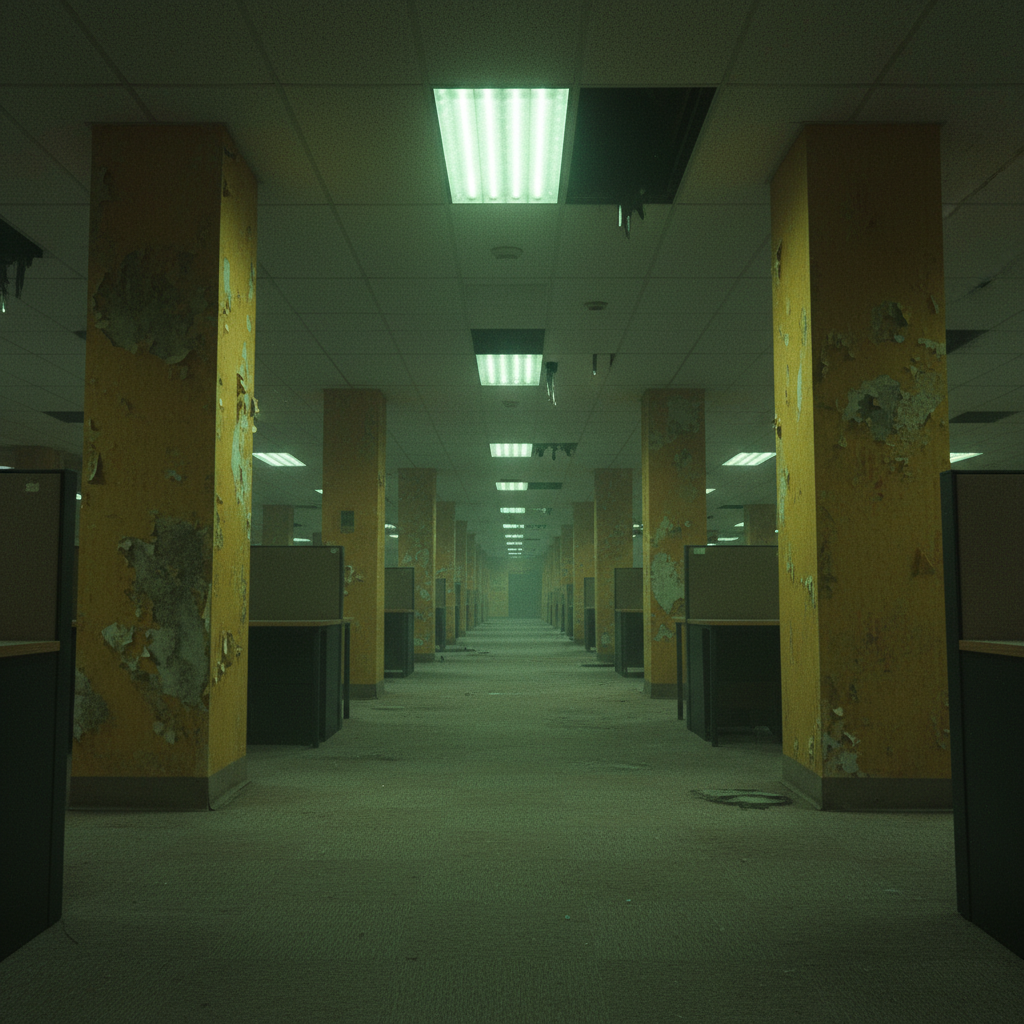
All modern myths have a point of origin, a digital patient zero. For The Backrooms, that moment is precisely timestamped: May 12, 2019. On the paranormal board of 4chan, known as /x/, an anonymous user initiated a thread inviting others to post "disquieting images." Another anonymous user responded with a photograph that would become iconic. The image depicted an empty, carpeted room bathed in a monochromatic yellow hue. Its walls, covered in a dated wallpaper pattern, met at an unnatural angle, leading the eye into a deeper, unseen corridor. The entire scene was illuminated by the harsh, unforgiving glow of fluorescent office lights.
This photograph, unsettling on its own, was not the sole catalyst. It was the accompanying caption that provided the spark. The text read: "If you're not careful and you noclip out of reality in the wrong areas, you'll end up in the Backrooms, where it's nothing but the stink of old moist carpet, the madness of mono-yellow, the endless background noise of fluorescent lights at maximum hum-buzz, and approximately six hundred million square miles of randomly segmented empty rooms to be trapped in. God save you if you hear something wandering around nearby, because it sure as hell has heard you."
This brief paragraph was a masterclass in narrative efficiency. It didn't just describe a place; it established a premise, a set of rules, and a palpable threat. The term "noclip"—a video game cheat code allowing players to pass through solid objects—brilliantly grounded this supernatural concept in the language of the digital age. It suggested that reality itself had a fragile code that could be glitched. This potent combination of a visually arresting image and a minimalist, lore-rich prompt was the Big Bang of The Backrooms universe. It was an invitation, and the internet's collective imagination accepted. You can find archival discussions about this very post, such as the origin of the backrooms was a post on 4chan, which document its viral spread.
The Digital Ecosystem: Liminality and Collective Myth-Making
The Backrooms did not emerge in a vacuum. It was the perfect predator for a digital ecosystem already primed by the aesthetic of 'liminal spaces'. A liminal space, from the Latin 'limen' meaning threshold, is a place of transition—an empty school hallway at midnight, a deserted shopping mall after closing, an airport terminal in the dead of night. These are locations we recognize, but stripped of their human context, they become unnerving and alien. The original Backrooms image is the quintessential liminal photograph, invoking a deep, unsettling sense of déja vu, a feeling of having been there in a dream or a half-forgotten memory.
This inherent connection to a burgeoning internet aesthetic explains its rapid proliferation. The initial 4chan post was merely the seed. It was planted in the fertile grounds of platforms like Reddit, where communities such as r/TheBackrooms and r/LiminalSpace quickly formed to expand the lore. YouTube creators began producing found-footage style videos, audio logs from fictional explorers, and detailed analyses of its psychological horror. The narrative was no longer owned by a single author but became a collaborative project, a form of open-source storytelling. This process perfectly exemplifies the mechanics of The Global Encyclopedia of Urban Legends, where a story's survival and evolution depend on its ability to be shared, adapted, and expanded by the community. Unlike traditional horror, where an author dictates canon, The Backrooms was built by consensus, with its most resonant ideas rising to the top through a process of cultural natural selection.
The Architectural Uncanny: Why We Fear the Yellow Rooms
At its core, the horror of The Backrooms is profoundly psychological, tapping into a primal substrate of human anxiety. It weaponizes the concept of the 'Uncanny Valley'—not for humanoid robots, but for architecture itself. These are spaces that are almost familiar, yet fundamentally wrong. The geometry is slightly off, the scale is impossibly vast, and the purpose is terrifyingly absent. This familiarity is what makes it so disturbing; our brains try to map these rooms onto our memories of offices, hotels, or basements, but the patterns refuse to resolve, creating a state of cognitive dissonance.
The concept of 'kenopsia'—the eerie, forlorn atmosphere of a place that is usually bustling with people but is now abandoned and quiet—is central to its effect. The humming lights and the smell of damp carpet are sensory anchors to a place devoid of life, amplifying a profound fear of isolation. The infinite nature of The Backrooms triggers a form of spatial agoraphobia, where the sheer endlessness of the environment is as suffocating as a tight space. It is a prison with no walls, only more rooms. Exploring this lore is a modern form of digital exploration, akin to the psychology of legend tripping, where participants seek out haunted or legendary locations. Here, the location is a shared mental space, a non-Euclidean nightmare built from the collective subconscious of the internet.
The Evolution of a Modern Mythos
The Backrooms' journey from a single image to a sprawling multimedia franchise illustrates a new paradigm for myth-making in the 21st century. Its development can be charted across distinct eras, each characterized by a different mode of creation and engagement. This decentralized, image-first genesis starkly contrasts with traditional legends, which typically originate from oral traditions or singular literary works. The lore didn't spring fully formed from one mind; it was layered, piece by piece, by thousands of anonymous contributors.
The following table outlines this unique evolutionary path:
| Era | Key Characteristics | Primary Platforms |
|---|---|---|
| Foundational Era (2019) | Singular image and caption. Lore is simple, focused on the horror of Level 0. Creation is spontaneous and chaotic. | 4chan, Reddit |
| Expansion Era (2020-2022) | Community-driven world-building. Introduction of hundreds of "Levels," mysterious "Entities," and survivalist "Factions." Lore becomes complex, sometimes contradictory. | Fandom/Wikidot Wikis, YouTube |
| Mainstream & Curated Era (2022-Present) | High-production value content (e.g., Kane Pixels' series) establishes a more coherent, "canonized" narrative. Spawns popular video games and film adaptations. | YouTube, Steam, Film Studios |
This evolution, meticulously documented on resources like the The Backrooms - Wikipedia page, shows a fascinating transition from a folk process to a commercialized intellectual property. It retains its collaborative spirit at the wiki level while also supporting more polished, auteur-driven interpretations.
Future Trajectories: The Backrooms in the Algorithmic Consciousness
The future of The Backrooms is intrinsically tied to the technologies that will shape our perception of reality. As a concept, it is perfectly suited for the immersive potential of virtual and augmented reality. VR horror games are already attempting to capture its disorienting essence, but future iterations could offer truly endless, procedurally generated labyrinths that adapt to a player's psychological state, crafting a uniquely personal horror experience. The line between playing a game and genuinely feeling lost could become terrifyingly thin.
Furthermore, the rise of generative AI presents a fascinating and unsettling possibility. AI image generators can now create infinite variations of liminal spaces and Backrooms levels on command, while large language models could write endless, unique accounts of those trapped within. The mythos could become truly infinite, a self-perpetuating narrative machine that constantly generates new content, blurring the lines between human and algorithmic creation. The Backrooms may be one of the first modern internet ghost stories 2026 to be co-authored by artificial intelligence. It began as a warning about glitching out of reality, and its future may involve a reality where the line between the real world and a simulated, endless, yellow-walled nightmare is no longer clear at all. Its legacy is not just a collection of scary stories, but a blueprint for how humanity will build its myths in an age of infinite information and artificial consciousness.